

Attestation
Apostille Notarization in Dubai: What Applies to Your Document
Apostille notarization sounds like one service, but it is two separate steps from two different systems. Notarisation confirms who signed a document. An apostille is a certificate that countries in the Hague Apostille Convention use to accept each other’s documents.
The catch for a document signed in Dubai is that the UAE is not a party to that Convention. So the route that applies here is notarisation first, then attestation. We explain the order below.
Apostille and Notarisation Are Two Different Steps
A notary public checks the signer and records the signature or the act. The notary does not decide where the document will be accepted.
An apostille is added later, by a government office, to prove that a public official’s signature or stamp is genuine. People often search “notary and apostille” together because many countries ask for both. The first step is still the notary. You can read more on what a notarised document is on our page about a notarized document in the UAE.

Why a UAE Document Is Attested, Not Apostilled
The UAE is not a party to the Hague Apostille Convention. A document signed in the UAE therefore follows a different chain, called attestation or legalisation.
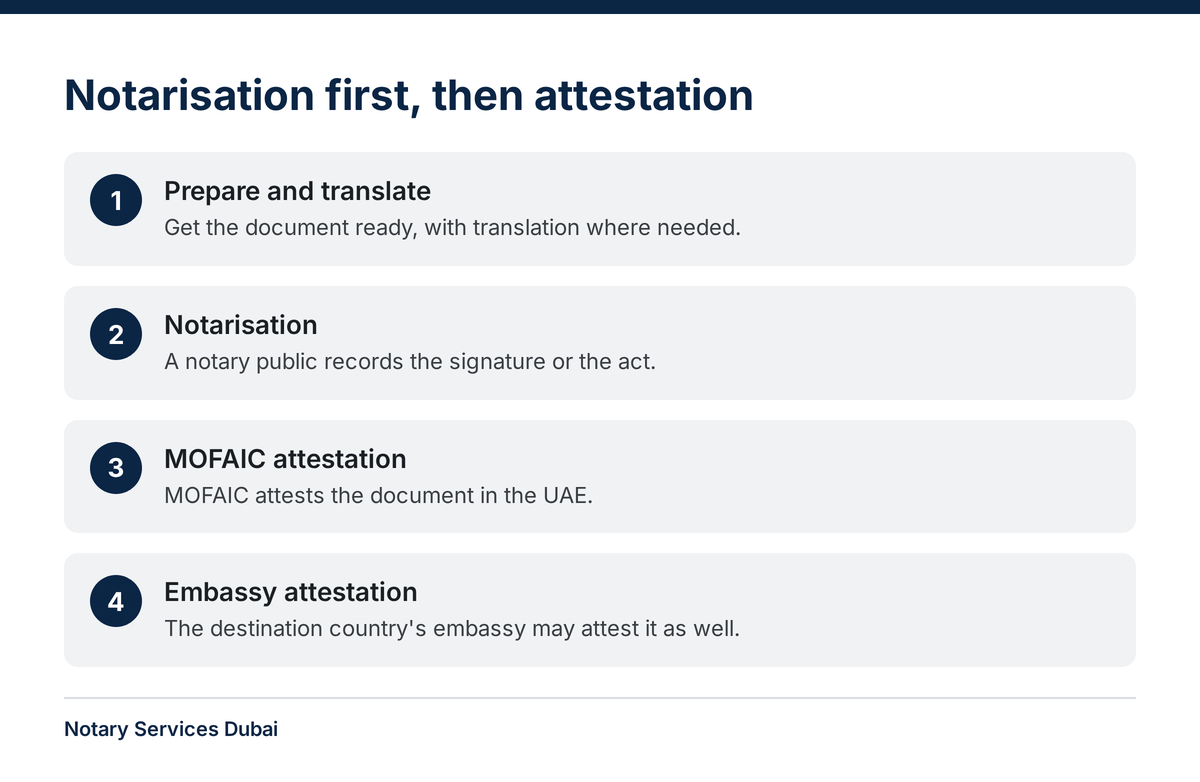
In practice, the steps usually run in this order:
- The document is prepared and, where needed, translated.
- It is notarised.
- The Ministry of Foreign Affairs (MOFAIC) attests it in the UAE.
- The embassy of the country where you will use it may attest it as well.
MOFAIC attests documents in the UAE. Its fees are AED 150 for personal documents and AED 2,000 for commercial documents. Translation, embassy and notary fees are separate. For the full chain, see our page on document attestation in Dubai.
Notarisation First: What Our In-House Notary Does
Our in-house notary public works from our Business Bay office. We notarise your document there, or we can arrange notary public services online or at your home. Our job at this stage is to prepare your document, take care of the notarisation and guide you to the attestation step that follows.
Before you come, send us the document and tell us the country where it will be used. We can then tell you what the destination asks for. Notarisation fees depend on the document. Ask us for the current figure, or read about notary public fees in Dubai.
Talk to us
Tell us what the document is and where it will be used, and we will tell you the next step.
Notarization, Apostille and Legalization Compared
The three words are often mixed up. This table separates them.
| Notarisation | Apostille | Legalisation (attestation) | |
|---|---|---|---|
| What it does | Records who signed or the act | Certifies an official’s signature for Convention countries | Chain of attestations for countries outside the Convention |
| Who does it | A notary public | The issuing country’s authority | Ministry offices and embassies |
| Applies to a UAE document? | Yes, first | No, the UAE is not a party | Yes, after the notary |
Documents From an Apostille Country Coming to the UAE
Documents also travel the other way. A document issued in an apostille country and meant for use in the UAE does not skip the UAE chain just because it has an apostille. Foreign documents are attested in the issuing country, including at the UAE embassy there, and then by MOFAIC in the UAE.
Check the order before you pay for any step. Doing the steps in the wrong order is a common reason a document is turned away.
What to Bring for Notarisation
Bring the original document and the passport or Emirates ID of each signer. If the document is in a language the receiving office does not read, tell us before you come, so we can handle the translation. Translations for official use are done by a legal translator registered with the UAE Ministry of Justice.
Do not sign before you reach the notary. A document signed in advance, or with blank fields, is a common reason for it to be turned away. If you are not sure whether your document needs a notary at all, our page on the meaning of notary public explains what a notary does and does not check.
Common Mistakes
- Asking for an apostille on a document signed in the UAE.
- Skipping translation when the receiving office needs another language.
- Notarising a document with blank fields.
- Starting attestation before the notary step is complete.
FAQ
Frequently Asked Questions
What is the difference between notarization and apostille?
Notarisation confirms the signature or the act before a notary. An apostille certifies an official’s signature so another Convention country accepts it. For a UAE document, notarisation comes first and attestation follows.
What does apostille notarization mean?
It usually means a document that needs both a notary and an apostille. For a document signed in the UAE, the apostille step does not exist, because the UAE is not a party to the Convention. The document is attested instead.
Does an apostille come after notarization?
In Convention countries, yes: the notary signs first and the apostille is added after. In the UAE the same place in the order is taken by MOFAIC attestation. Read our guide to document attestation in Dubai.
What is the difference between notarization, apostille and legalization?
Notarisation is the notary’s act. An apostille is a single certificate for Convention countries. Legalisation is the longer chain of attestations used where there is no apostille.
Is the UAE part of the Apostille Convention?
No. The UAE is not a party, as the Hague Conference status table shows. Documents for use abroad are attested instead.
More answers, grouped by topic, are on our questions and answers page.
Keep reading
Related guides and services



More pages you may need
Get started
Talk to Us About Your Document
Call or WhatsApp +971 54 380 1094, or email support@notaryservicesdubai.com. Tell us what the document is and where it will be used, and we will tell you the next step. Our office is at Empire Heights Tower B, Marasi Drive, Business Bay, Dubai, UAE, open Monday to Friday, 9:00 am to 6:00 pm. WhatsApp and online requests are answered 24/7.