
Guide
Notary public meaning, and what notarised means for your document
The notary public meaning is simple: a notary public is a legal official who witnesses you sign a document, checks your identity, and then seals or stamps it so it can be trusted by whoever asks for it. At Notary Services Dubai, our in-house notary public does this in person at our Business Bay office, online, or on a home visit. If a bank, court, school or government office has told you to get something “notarised”, this page explains what that word means and what happens at each step.
Quick answer
At a glance
- A notary public witnesses signatures, checks identity, and applies an official seal.
- “Notarised” means a document has been through that process and carries the notary’s seal and signature.
- In Dubai, notarial acts are carried out by the Dubai Courts notary public or a licensed private notary, both regulated under Dubai Law No. 4 of 2013 concerning Notaries Public in the Emirate of Dubai.
- Notarisation, attestation and a certified true copy are three different processes, not the same thing.
- We notarise your document with our in-house notary public, in person, online or at your home, and handle the MOFAIC step if it needs attestation.
What is a notary public?
A notary public is a legal official authorised to witness the signing of documents, confirm the identity of the people signing, and certify that a document or a copy of it is genuine. The role exists so that a court, bank, government department or foreign authority can trust a document without having met the people who signed it.
Federally, the notary profession in the UAE is regulated under Federal Decree-Law No. 20 of 2022 on the regulation of the notary profession. In Dubai specifically, Dubai Law No. 4 of 2013 sets out who can act as a notary public: the Dubai Courts notary public (a government office) and licensed private notaries, who are lawyers approved by Dubai Courts and listed on its roll.
A notary public is not the same as a lawyer who simply advises you. The person who performs the notarial act, meaning witnesses your signature and applies the seal, has to be a notary public recognised under Dubai law.
What does notarised mean?
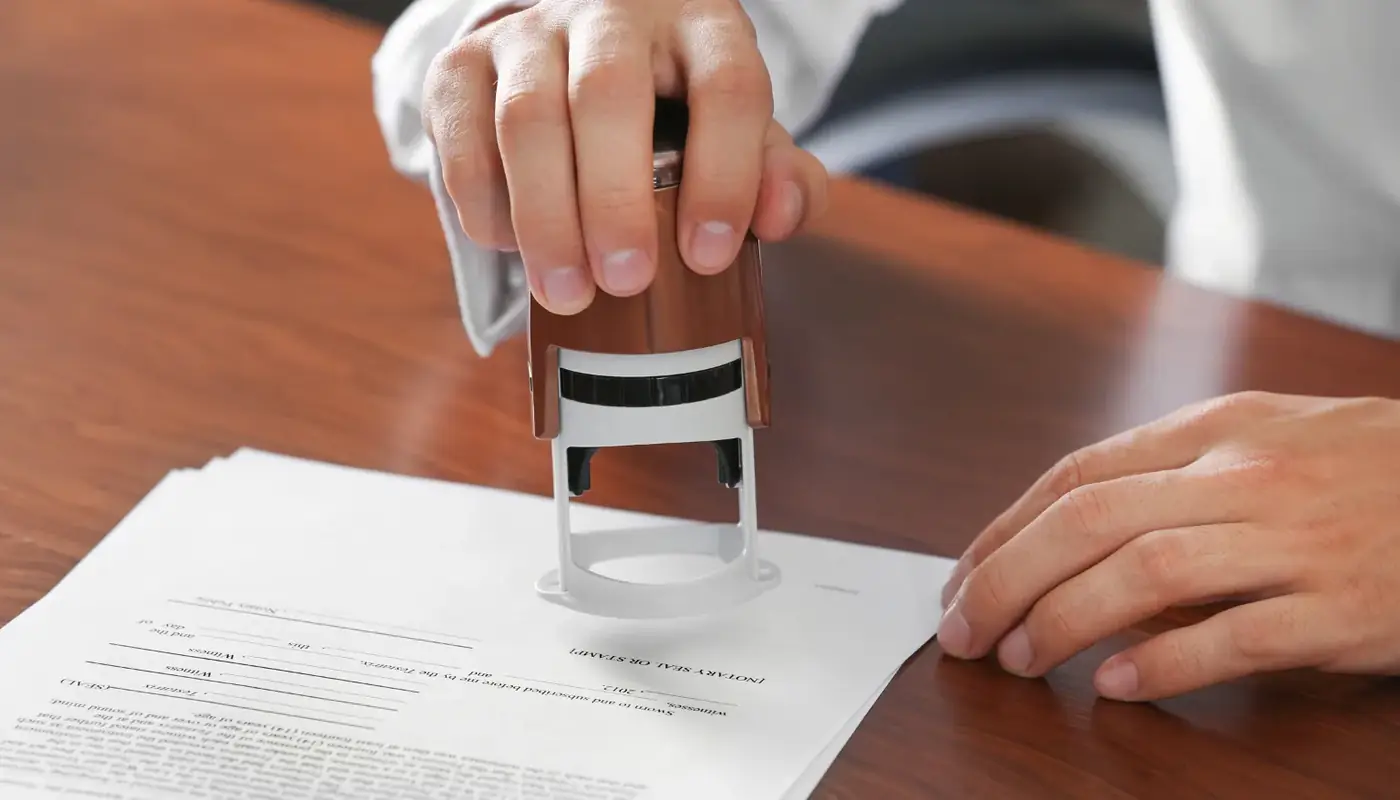
Notarised means a document has been signed in front of a notary public, who has checked the signer’s identity, confirmed they are signing willingly, and then added their official seal, stamp and signature. Once that happens, the document is a notarised document.
Notarisation does not usually judge whether the content of a document is correct, fair or enforceable. It confirms who signed it, that they did so knowingly, and, in some cases, that a copy matches an original. A notary is a witness and certifier, not a judge of the document’s contents.
In the UAE, notarial instruments are drawn up in Arabic, with a conditional exception. A bilingual version alongside the Arabic is common practice, though there is no general rule that every notarised document must be bilingual.
What is a notarised letter?
A notarised letter is any letter that has been signed in front of a notary public and carries their seal, rather than just a signature on plain paper. People ask for a notarised letter when the person or organisation receiving it needs proof that the signer’s identity was checked and that they signed it themselves.
Common notarised letters people ask us to arrange include:
- A letter of consent, for example a parent giving permission for a child to travel with one parent or another adult.
- An authorisation letter, for example authorising someone to collect a document, act on your behalf for a specific task, or handle a transaction while you are away.
- A residency or status letter, sometimes needed alongside a declaration of residency for a visa, school or bank process.
Each of these starts as a normal document. What makes it a notarised letter is the signing in front of the notary and the seal that follows.
What is a notarised letter of consent?
A notarised letter of consent is a letter in which someone gives formal permission for something to happen, most often a parent consenting to a child travelling, and has that consent witnessed and sealed by a notary public. Airlines, immigration officers and schools ask for it because a plain signed letter can be written by anyone, while a notarised one has been through an identity check.
Talk to us
Tell us what the document is and where it will be used. We check it and notarise it in person, online or at your home.
What is notary attestation?
People often use “notary attestation” to describe the general idea of getting a document officially recognised, but attestation and notarisation are technically two different steps done by different bodies.
Notarisation is carried out by a notary public and confirms the signing itself. Attestation is a separate, later step carried out by a government authority, most often the Ministry of Foreign Affairs and International Cooperation (MOFAIC) in the UAE, which confirms that a document, seal or signature is genuine so the document can be used in another country or by another government department. A document usually has to be notarised (or issued by a competent authority) before it can be attested.
It is worth knowing that the UAE is not a party to the Hague Apostille Convention, so there is no apostille route for documents used in or issued from the UAE. Foreign documents instead follow a legalisation chain: attestation in the country where the document was issued, then MOFAIC attestation once the document is in the UAE.
Notarised copy vs certified true copy
A notarised copy and a certified true copy are two names people use somewhat interchangeably, but there is a useful distinction. A certified true copy is a copy of an original document that a notary, or in some contexts another authorised person, confirms matches the original word for word. The notary is not certifying the content is true, only that the copy is an accurate reproduction of the document shown to them.
“Notarised copy” is often used loosely for the same thing. If you are asked for a certified true copy of a passport, degree certificate or bank statement, you need the original document plus the copy, and the notary compares them before sealing the copy. If you only have the copy and not the original, a notary generally cannot certify it. For the full process on a specific document, see our page on certified true copy attestation in Dubai.
Who can act as a notary in the UAE
There are three routes people usually mean when they talk about getting something notarised in Dubai:
- The Dubai Courts notary public. This is the government notary office, and it handles a wide range of notarial acts including powers of attorney, declarations and affidavits.
- A licensed private notary. These are lawyers licensed by Dubai Courts to act as notaries, listed on the roll Dubai Courts keeps. For how the two compare, see public vs private notary.
- The Ministry of Justice E-Notary system. This is the federal government’s system for remote or electronic notarisation for eligible services. It is run by the Ministry of Justice, not by any private company, and a private provider should never claim to be that system.
For a fuller explanation of the private notary role and how appointments work in Dubai, see notary public in Dubai.
When you need something notarised
You generally need a document notarised when the person or organisation receiving it cannot verify on their own that you signed it, or that a copy is genuine. That comes up in situations such as:
- Powers of attorney, so someone can act on your behalf for property, a company, a court case or a personal matter.
- Consent letters for a child travelling without both parents.
- Affidavits and declarations, for example a declaration of residency or an affidavit of single status.
- Certified true copies of documents like a passport, degree certificate or bank statement, when the receiving authority wants a notary’s confirmation the copy matches the original.
- Company documents such as a memorandum of association or a board resolution, when a notarial act is part of the process.
If you are not sure whether your specific document needs notarising, attesting, or both, our page on how to notarise documents in Dubai walks through the general process step by step, and our documents attestation in Dubai page covers the attestation chain in more detail.
How we help
Notary Services Dubai provides notary services and notary attestation support built around exactly this process. There are three ways to get it done: in person at our Business Bay office with our in-house notary public, through our online notary public services, or on a home visit. We prepare your document so it is ready for signing and check it against what the receiving authority will expect. For attestation, we take care of the MOFAIC step on your behalf.
Our in-house notary public checks your identity, watches you sign, and applies the official seal. That signing and sealing is the notarial act itself. We cover everything around that moment too: preparing, drafting and translating the paperwork, and handling attestation once the document is notarised.
If you need a document prepared and notarised, contact us on +971 54 380 1094 (also WhatsApp) or by email at support@notaryservicesdubai.com, and we will confirm the next step. Our office is at Empire Heights Tower B, Marasi Drive, Business Bay, Dubai. Office open Monday to Friday, 9:00 am to 6:00 pm. WhatsApp and online requests answered 24/7.
FAQ
Frequently asked questions
What is a notary public?
A notary public is a legal official who witnesses signatures, checks identity, and certifies documents or copies as genuine. In Dubai, this is either the Dubai Courts notary public or a licensed private notary.
What does notarised mean?
Notarised means a document has been signed in front of a notary public, who confirmed the signer’s identity and applied an official seal and signature. It shows the signing itself has been verified, not necessarily that the content is legally correct.
What is a notarised letter?
A notarised letter is a letter, such as a consent or authorisation letter, that has been signed in front of a notary public and carries their seal. It is used when the recipient needs proof the signer’s identity was checked.
What is notary attestation?
“Notary attestation” is often used loosely, but notarisation and attestation are separate steps. Notarisation is done by a notary public and confirms the signing. Attestation is a later step, usually done by MOFAIC, confirming the document or seal is genuine for use elsewhere.
What is a notary public in Dubai?
In Dubai, a notary public is either the government Dubai Courts notary public or a private notary, a lawyer licensed by Dubai Courts to act as a notary. Both are regulated under Dubai Law No. 4 of 2013.
What does notary public mean on an application form?
On a form that asks whether a document is notarised, it means the form issuer wants your signature or copy verified by a notary public before they accept it, rather than a plain unverified signature.
What is a notarised letter of consent?
A notarised letter of consent is a permission letter, commonly for a child’s travel, that has been signed in front of a notary public and sealed. Airlines and immigration authorities ask for this because it confirms who signed the consent.
What is the difference between a notarised copy and a certified true copy?
The two terms are largely used to mean the same thing: a copy of an original document that a notary has compared to the original and certified as a true match. The notary certifies the copy is accurate, not that the document’s content is true.
More answers, grouped by topic, are on our questions and answers page.
Keep reading
Related guides and services

Services
Notary public in Dubai
How a notary public works in Dubai, the Dubai Courts, private notary and MOJ e-notary routes, and how we prepare your paperwork and book the appointment.
Read more

Notary Services Dubai
Private notary services
Get your document done by a Dubai-licensed private notary. We prepare it, translate it if needed and book your appointment, step by step.
Read more

Guide
Public vs private notary
Public notary or private notary in Dubai? A plain comparison of who they are, what they handle, hours and cost, so you know which route fits.
Read more
Reviews
What clients say
Read what people we have helped say about us on our Google profile, or read about Notary Services Dubai.
Get started
Talk to us about your document
Call or WhatsApp +971 54 380 1094, or email support@notaryservicesdubai.com, and tell us what document you have and where it needs to be used. We are at Empire Heights Tower B, Marasi Drive, Business Bay, Dubai.