
Attestation
Dubai Consulate Attestation Process: Which Consulate Stamps Your Document
The Dubai consulate attestation process is the chain of stamps that makes a document accepted in another country, or in the UAE. Which consulate you need depends on one thing: whether the document is coming to the UAE or leaving it.
The catch most people miss is that “consulate attestation” has two meanings. For a document coming here, it is the UAE embassy or consulate abroad. For a document going out, it is the foreign consulate in Dubai. Mixing them up sends you to the wrong office.
What Consulate Attestation Means
Consular attestation means an embassy or consulate confirms that the signature or seal of the previous official on your document is genuine. It does not check that the content is true. It is one link in a chain, and the chain must be followed in order.
The UAE is not a party to the Hague Apostille Convention, as the Hague Conference status table shows. That is why one stamp from the issuing country is not enough here, and why consulates are involved at all.
Documents Coming to the UAE: the UAE Embassy or Consulate Abroad
For a document issued in another country, the UAE embassy attestation process happens in that country, before the document arrives. The usual order is:
- The document is issued, or a copy is notarised, in the issuing country.
- The issuing country’s foreign ministry attests it.
- The UAE embassy or consulate in that country attests it.
- MOFAIC in the UAE attests it, as set out on the MOFAIC attestation page.
MOFAIC fees are AED 150 for personal documents and AED 2,000 for commercial documents. Fees charged abroad, and the order your embassy follows, are set by that country, so check them before you start. Our guide to document attestation in Dubai, from lawyer to MOFAIC covers the UAE end in detail.
If the document is a degree or a marriage certificate, see our pages on degree certificate attestation and marriage certificate attestation.
Talk to us
Tell us what the document is and where it will be used, and we will tell you the next step.
Documents Leaving the UAE: Notary, MOFAIC, Then the Destination Consulate
For a document made in Dubai and used abroad, the order runs the other way. The consulate attestation Dubai step comes last, at the consulate of the country where the document will be used.
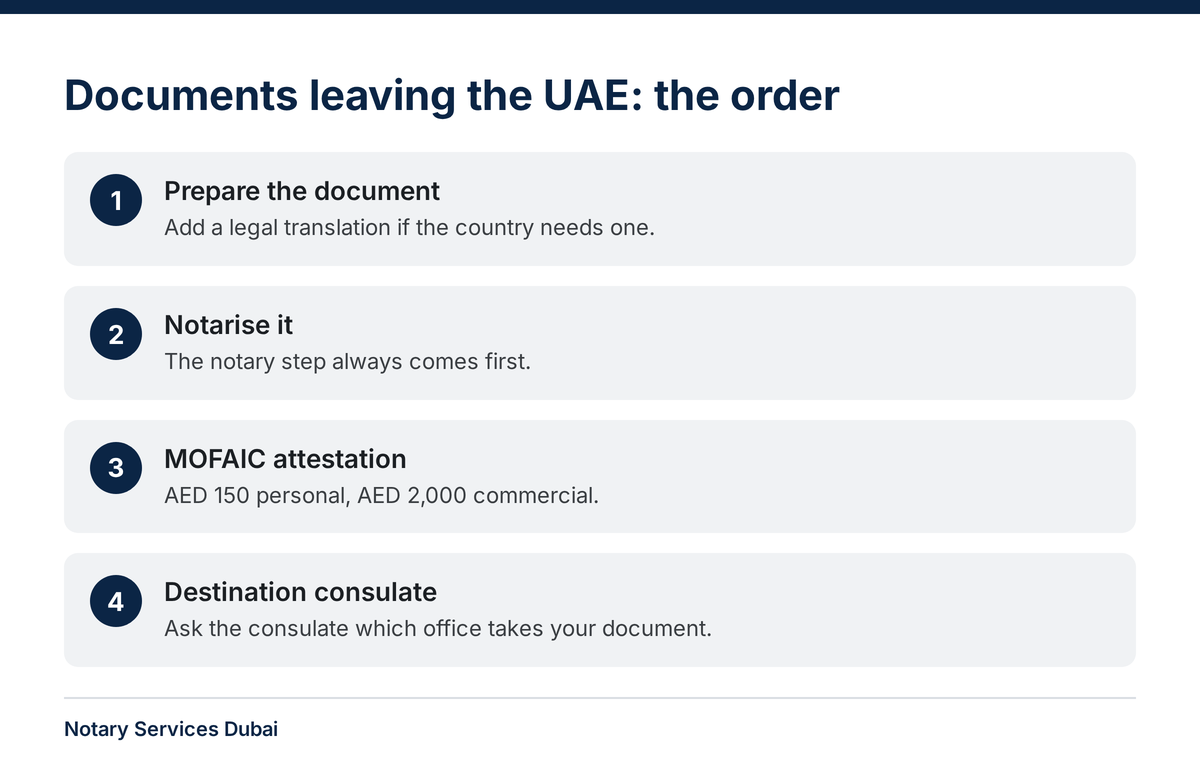
- Prepare the document, with a legal translation if the receiving country needs one.
- Have it notarised.
- Have MOFAIC attest it.
- Take it to the consulate or embassy of the destination country in the UAE.
Many countries have their consulate in Dubai and their embassy in Abu Dhabi. Each one sets its own appointment system, forms and rules for consulate attestation in UAE offices, so ask the consulate which office takes your document type.
Translations for official use are done by a legal translator registered with the UAE Ministry of Justice. Notarising a translation in the instrument costs AED 50 per page under the federal fee schedule.
Where the Notary Step Fits
In the Dubai consulate attestation process, the notary comes first, before MOFAIC and before any consulate. Without a notarised document, MOFAIC has nothing to attest, and the consulate has nothing to confirm.
In Dubai, a private notary is a lawyer licensed by Dubai Courts to carry out notarial acts. We prepare and draft your document, translate it where needed, and handle your notarisation at our Business Bay office, online or at your home. Then we guide you through the MOFAIC and consulate steps that follow.
Some consulates also offer their own notarial services for their citizens. Where that is the case, the consulate may be the right route, and we will say so. Read our page on notarial services at the Philippine consulate in Dubai for an example, and our page on Indian notary and document attestation.
For how the notary step itself works, see how to notarise a document in Dubai.
What to Check Before You Start the Dubai Consulate Attestation Process
Most rejections come from a skipped step or a mismatch. Check these first:
- the country where the document will be used, and its consulate’s current requirements
- whether the document is personal or commercial, because MOFAIC fees differ
- whether the original is needed or a certified copy is accepted
- that names and dates match across every document in the file
- whether a legal translation is needed, and into which language
- the order of stamps: notary, MOFAIC, then consulate

Our own service fee depends on the document, so ask us for the figure when you send it. Government, translation and consulate fees are separate. See notary public fees in Dubai for how the cost is made up.
FAQ
Frequently asked questions
What is consular attestation?
Consular attestation is when an embassy or consulate confirms that the signature or seal on your document is genuine. It is one step in a chain and does not check that the content is true. The consular attestation meaning is the same whether the document is coming to the UAE or leaving it.
What is the UAE embassy attestation procedure?
For a document issued abroad, the UAE embassy or consulate in that country attests it after the foreign ministry there. Then MOFAIC attests it in the UAE. Each country sets its own local steps and fees.
What are the UAE embassy attestation requirements?
Requirements are set by the embassy and the issuing country, so they vary. Expect to need the original or a notarised copy, your passport details and any prior attestations. Ask the embassy for its current list before you travel or post anything.
Where does the notary step come in the attestation process?
The notary step comes first for a document made in Dubai. After it, MOFAIC attests the document, and then the destination country’s consulate. Our guide to power of attorney attestation in Dubai shows this order for one common document.
What is the UAE certificate attestation process?
For a certificate from abroad, it runs through the issuing country’s authorities, the UAE embassy there, then MOFAIC here. For a certificate issued in the UAE and used abroad, it runs through the notary, MOFAIC, then the destination consulate. Send us the certificate and tell us where it will be used.
More answers, grouped by topic, are on our questions and answers page.
Keep reading
Related guides and services



More pages you may need
Get started
Send Us Your Document
Call or WhatsApp +971 54 380 1094, or email support@notaryservicesdubai.com. Tell us what the document is and where it will be used, and we will tell you the next step. Our office at Empire Heights Tower B, Marasi Drive, Business Bay is open Monday to Friday, 9:00 am to 6:00 pm. WhatsApp and online requests are answered 24/7.