

Notary Services
Is Online Notary Legal in the UAE? What Makes It Valid
Is online notary legal? In the UAE, yes: the Ministry of Justice runs an E-Notary System for remote notarisation, so a document can be notarised without you travelling to an office. What matters is who carries out the act, what they check and whether the place that will receive your document accepts it.
Many people lose time here. They sign a paper at home, call it “notarised online” and then find the receiving office wants a proper notarial act. The checks below stop that.

Is Online Notary Legal in the UAE? The Legal Basis
Notarial acts in the UAE are regulated by Federal Decree-Law No. 20 of 2022 on the regulation of the notary profession. In Dubai, notaries public are also regulated by Dubai Law No. 4 of 2013. Dubai has a Government notary public at Dubai Courts and licensed private notaries on a roll kept by Dubai Courts.
A private notary in Dubai is a lawyer licensed by Dubai Courts to carry out notarial acts. The word “notary” on its own does not tell you whether the person can do this, so ask who the notary is and what authority they work under.
So when people ask whether online notary is legal, the answer depends on the route. A scan signed and sent by email is not a notarial act. A video call with a licensed notary who carries out the act is a different thing. That difference is the answer to “can you notarize online”.
The government remote notarisation channel
The UAE Ministry of Justice runs the E-Notary System for remote notarisation. It is the government’s own channel. We are not that system, and we explain it here so you can compare your options. DIFC Courts runs a separate notary service for DIFC matters, so a DIFC document may need a different route.
You can read a step by step account on our page about e-notary in Dubai and the UAE.
Talk to us
Tell us what the document is and where it will be used, and we will tell you the next step.
What the notary checks on a video call
Whichever route you use, a notary checks the same basics before any act:
- Who you are. Your identity document is shown and matched to your face.
- That you understand the document. If it is in a language you do not read, you need a translation first.
- That you sign willingly. You sign on the call, with the notary watching.
- That the document is complete. Blank fields are a common reason for refusal.
- That the act fits the document. A power of attorney, an affidavit and a signature authentication are different acts.
Translations for official use are done by a legal translator registered with the UAE Ministry of Justice. If your document needs one, we translate it and handle your notarisation together.
Documents and offices that accept it
Not every office accepts every document in every form. Before you start, ask the office that will receive the document what it needs. Tell us what the document is and where it will be used, and we confirm whether it can be done online or whether you should come to our Business Bay office or have a home visit.
Some cases need extra steps:
- A UAE document used abroad. The UAE is not a party to the Hague Apostille Convention, so the document is attested by MOFAIC in the UAE and then by the embassy of the country where it will be used.
- A foreign document used in the UAE. It is attested in the issuing country, including the UAE embassy there, and then by MOFAIC. MOFAIC fees are AED 150 for personal documents and AED 2,000 for commercial documents.
- A DIFC matter. Use the DIFC Courts notary service.
How our online notary public service works
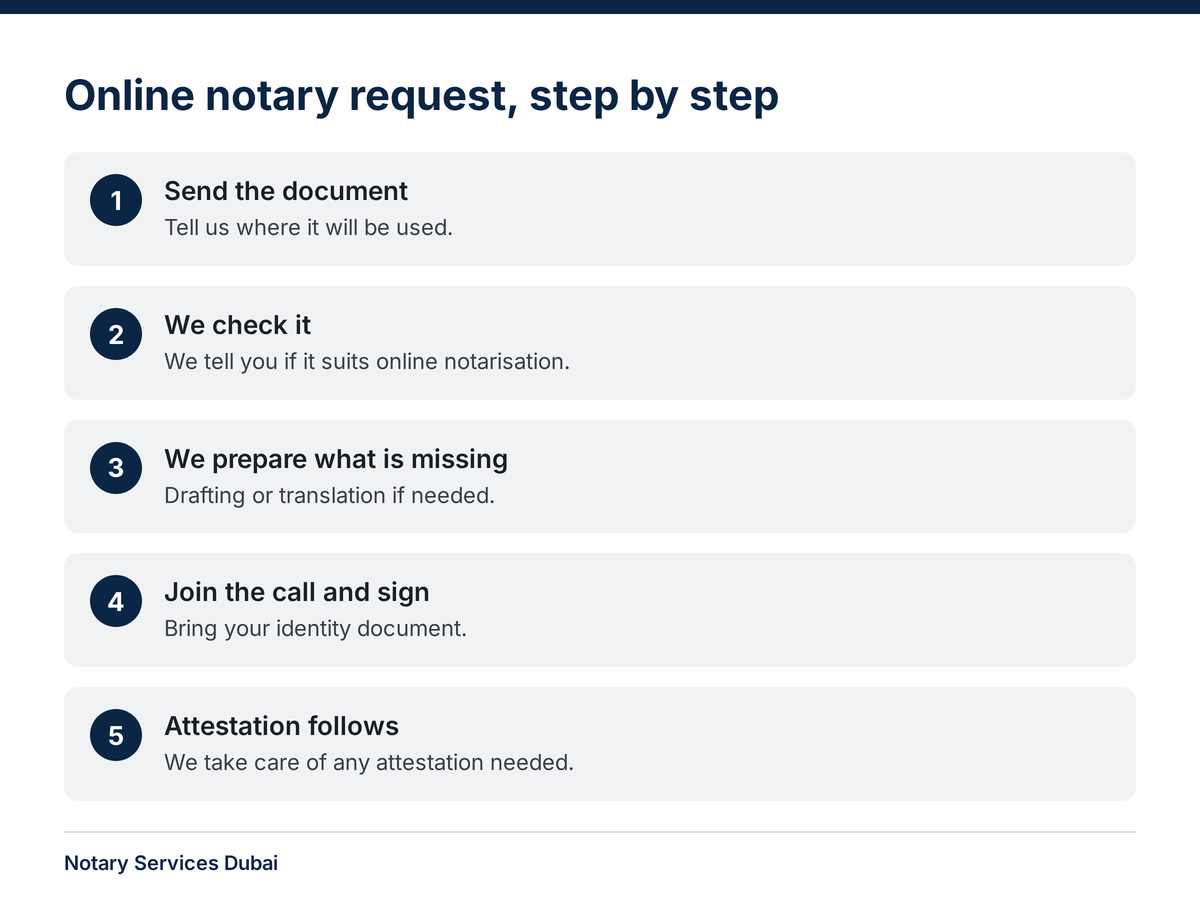
We offer online notary public services as well as in-house notary public services at our Business Bay office and home visit notary services. For an online request:
- You send the document and tell us where it will be used.
- We check it and tell you whether it suits online notarisation.
- We prepare, draft or translate what is missing.
- You join the call with your identity document and sign.
- We take care of any attestation that follows.
We confirm our fee when you send the document. Government fees, translation and attestation are separate. For the full picture, see our page on online notary services in Dubai.
FAQ
Frequently asked questions
Can you get a document notarized online?
Yes, for many documents. The Ministry of Justice E-Notary System handles remote notarisation, and a licensed notary can carry out the act on a video call. Whether your document qualifies depends on its type and where it will be used, so send it to us first.
Can you notarize virtually?
Yes, when the notary carries out the notarial act on a live call. Signing a paper alone and sending a photo is not the same. The notary must see you, check your identity and watch you sign.
Is there an online notary in the UAE?
Yes, and online notary is legal when a licensed notary carries out the act. The Ministry of Justice runs the E-Notary System, and we also provide online notary public services. They are different things, and we never present ours as the government system.
Is a remotely notarised document accepted abroad?
It may be, but the country receiving it decides. For use abroad, the UAE chain is notarisation, then MOFAIC attestation, then the embassy of that country. Ask the receiving office first, then talk to us about the order.
Can I get a document notarised online from outside the UAE?
Often yes, if the route suits your document and you have the right identity papers. Tell us the country you are in and where the document will be used, and we will tell you whether online works or whether your own embassy is the better route. See our page on private notary services in Dubai for the other ways we work.
More answers, grouped by topic, are on our questions and answers page.
Keep reading
Related guides and services



Get started
Next step
Call or WhatsApp +971 54 380 1094, or email support@notaryservicesdubai.com. Tell us what the document is and where it will be used, and we will tell you the next step. Our office is open Monday to Friday, 9:00 am to 6:00 pm. WhatsApp and online requests are answered 24/7.